
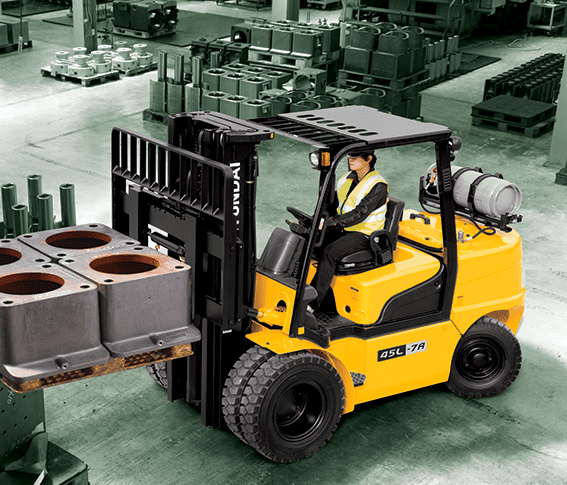
In automotive material handling, parts arrive from Tier 1 and Tier 2 suppliers in sequence, each one assigned to a specific position on the assembly line at a precise time. When the machine executing that pull fails, the delivery window closes fast, and the downstream cost of an unplanned line stop at a high-volume auto plant can climb into five figures per hour. The Hyundai forklift fleet serving a JIT operation has to be reliable enough that it never becomes the reason the line stops.
What JIT Production Actually Demands From an Industrial Forklift
Just-in-time production is a delivery commitment built around the complete absence of buffer stock. Parts arrive from Tier 1 and Tier 2 suppliers in precise sequence, each component assigned to a specific line position at a specific time, and there is nothing in the system to absorb a timing error caused by equipment going down mid-shift.
When the industrial forklift executing a JIT pull fails, the gap cascades through the assembly schedule and draws in logistics, production, and floor supervision all at once. Automotive material handling at this level of precision requires shift-length reliability, fuel continuity, and the ability to navigate production layouts that weren’t built around the forklift.
Effective forklift fleet management at a JIT facility starts with the right Class 4 forklift selection, and this piece builds on the capacity and layout foundation in our earlier post about Hyundai Class 4 performance in automotive and manufacturing environments by going deeper on the shift-level reliability that JIT delivery specifically demands.
The Pressures of Automotive Material Handling
Automotive material handling at a Tier 1 or Tier 2 supplier is measured by sequence adherence, which means whether the right component reached the right line position at the right time. Operations directors at these facilities hold their industrial forklift equipment to the same standard as every other variable in the production schedule: it either shows up reliably when the line needs it, or it doesn’t belong there.
When Sequence Delivery Leaves No Margin for Error
Just-in-sequence delivery assigns every component a window when it must be staged at the assembly line, and missing that window can trigger a cross-functional production adjustment involving supervisors, logistics coordinators, and line managers. The Hyundai forklift running a JIT pull has to complete that move cleanly and on schedule every time, with the same output at the end of a long shift as it delivers at the beginning of the first.
A Class 4 forklift selected for this environment, including the 6000 lb forklift class options in the Hyundai LC lineup, must hold consistent performance across the sustained multi-shift cycles that auto plants actually run. That is the baseline expectation in an automotive supply context.
Multi-Shift Schedules and the Fuel Gap Problem
Auto plants run two and three shifts routinely, and automotive material handling equipment has to stay operational across all of them. Electric forklift fleets hit a persistent challenge here because battery recharging takes hours, and shift handoffs rarely leave enough time for a full charge cycle before the next period of demand begins.
An LPG forklift removes that constraint entirely. A propane tank swap takes minutes rather than hours, which means a 6000 lb forklift running on LPG can transition between shifts without any gap in coverage or output. The LPG-powered internal combustion forklifts in the Hyundai Class 4 lineup deliver consistent performance with no decline as the operating window extends.
How the Hyundai Class 4 Forklift Answers the Call
The Hyundai Class 4 forklift was built for the specific conditions that indoor automotive manufacturing presents. Sealed production floors, tight assembly cells, sustained multi-shift cycles, and the component weights Tier 1 and Tier 2 suppliers handle every day are the operating conditions this equipment was engineered for.
The full Hyundai Class 4 lineup through Brennan offers LPG forklift configurations that scale to different facility layouts and capacity requirements without sacrificing the consistency that JIT delivery depends on.
LPG Refueling That Doesn’t Break the Shift
The refueling advantage of an LPG forklift in JIT service is practical and direct. A propane tank swap takes a few minutes, and the machine is back on the floor before the schedule has a chance to slip. A 6000 lb forklift in the Class 4 LPG configuration handles the component weights common in engine, drivetrain, and body panel supply while keeping pace with the shift cadence that auto plants run.
There is no dedicated charging infrastructure to budget for, no battery replacement cycle to plan around, and no gradual output decline as charge levels drop through the shift. An LPG forklift in this capacity class delivers the end-to-end consistency that a JIT pull schedule requires.
Hydrostatic Steering Built for Cell-Based Layouts
Work cells in an auto plant weren’t designed to accommodate oversized material handling equipment, and the Hyundai forklift Class 4 LC series accounts for that at the engineering stage. Hydrostatic power steering and a tight turning radius allow this Class 4 forklift to handle the aisle geometry and staging areas of cell-based production without requiring any changes to the facility layout to fit the machine. Operators running repeated JIT pull cycles in close-quarter sequences report lower fatigue across long shifts because the steering effort is reduced and the control response stays consistent through hours of repetitive operation. That ergonomic consistency is a production variable in an environment where operators are executing the same pull cycle dozens of times per shift.
Hi-Mate Connectivity for Proactive Forklift Fleet Management
Hi-Mate is Hyundai’s remote monitoring and telematics platform, and in automotive applications it changes the fundamental nature of forklift fleet management at the plant level. Instead of discovering an equipment problem when the lift fails mid-pull, fleet managers receive operating hours, fault code alerts, and maintenance status data for every unit before failure.
That proactive visibility is what separates automotive material handling operations that react to downtime from those that prevent it from reaching the floor. A Hyundai forklift fleet running Hi-Mate gives maintenance teams the ability to schedule service on the equipment’s timeline rather than the production schedule’s.
Brennan’s forklift fleet management services are structured to right-size your equipment footprint, anticipate service needs, and close the gap between planned maintenance windows and unplanned floor stops.
The Warranty That Backs Up the Uptime Promise
A reliability claim only carries weight when there is real coverage behind it. For a 6000 lb forklift class machine in daily JIT service, that warranty means a failure within the coverage window doesn’t become an unplanned capital event during a production surge.
The LPG forklift configuration in the Hyundai Class 4 line is particularly well-suited to sustained multi-shift demands, and pairing that warranty coverage with a proactive preventative maintenance program is what keeps the industrial forklift fleet performing across its full service life rather than reacting to problems after they surface.
Talk to Brennan About Hyundai Class 4 Equipment
The equipment decision for a JIT production environment comes down to whether a Class 4 forklift can sustain the pace, the shift coverage, and the reliability that automotive material handling at the plant level actually demands.
Brennan Equipment Services is an official Hyundai dealer with locations across Indiana and Ohio, positioned to serve the Tier 1 and Tier 2 networks running JIT operations. Whether you’re evaluating new equipment for a growing operation, building a forklift fleet management plan around your JIT schedule, or looking to rent forklifts to supplement your core fleet during a high-demand production window, our team can match the right machine to your facility.