On a busy manufacturing floor, the wrong forklift can do more than slow your team down. It creates bottlenecks at critical load points, chips away at uptime, and quietly adds cost to every shift. For procurement managers and operations leads in automotive assembly plants and general manufacturing facilities, understanding whether a Hyundai Class 4 forklift fits your environment is one of the most consequential questions you can ask.
What Is a Class 4 Forklift?
Forklifts are categorized by their design and intended operating environment. Class 4 forklifts are cushion-tire, internal combustion lifts engineered for the smooth, hard surfaces found in warehouses and indoor industrial facilities. The cushion tires give them a lower ride height and a tighter turning radius compared to their pneumatic-tire counterparts, making them well-suited for facilities where space efficiency matters as much as raw lifting power.
What separates a Class 4 from other warehouse forklifts is primarily its capacity range and engine design. These machines handle loads ranging from 3,000 to 15,000 pounds depending on configuration, which makes them the right answer when operations need a high capacity forklift without the bulk and operating costs of equipment designed for outdoor terrain. When Brennan customers in automotive and manufacturing environments start evaluating their options, the Hyundai Class 4 forklift comes up consistently as the right fit for the conditions those facilities present.
Why Manufacturing Floors Demand the Right Equipment
The demands placed on equipment in automotive assembly and general manufacturing settings are different from what you’d find in a standard distribution center. Load weights are higher, floor activity is more intense, and the tolerance for equipment failure is often close to zero. A few specific factors drive why equipment selection matters so much in these environments.
Consistent Load Cycles, Shift After Shift
Manufacturing environments don’t run intermittently. Forklifts in these settings are often in motion across multiple shifts each day, which means equipment reliability is a baseline requirement, not a bonus feature. Machines that can’t sustain performance across long operating windows create downstream problems that ripple across the entire production floor. The Hyundai Class 4 forklift is built to handle that kind of sustained demand without losing ground on performance as hours accumulate.
Tight Aisle and Facility Geometry
Automotive plants and manufacturing facilities are designed around production flow, not forklift access. Aisles are frequently narrower than in purpose-built warehouses, and staging areas are often shared with other equipment and personnel. A forklift with a compact footprint and a tight turning radius handles this geometry without requiring wholesale workflow redesign to accommodate the machine.
Indoor Operating Conditions
Class 4 equipment is built for hard, flat surfaces, and most manufacturing floors meet that standard. These facilities are also typically enclosed environments where outdoor-grade pneumatic tire equipment would be an overcorrection that drives up costs without adding operational value. Matching machine type to actual floor conditions keeps acquisition costs, fuel costs, and wear rates in the right range over time.
Check out the Hyundai forklifts available through Brennan to find the right equipment for your automotive or manufacturing operations.
What Sets the Hyundai Class 4 Forklift Apart
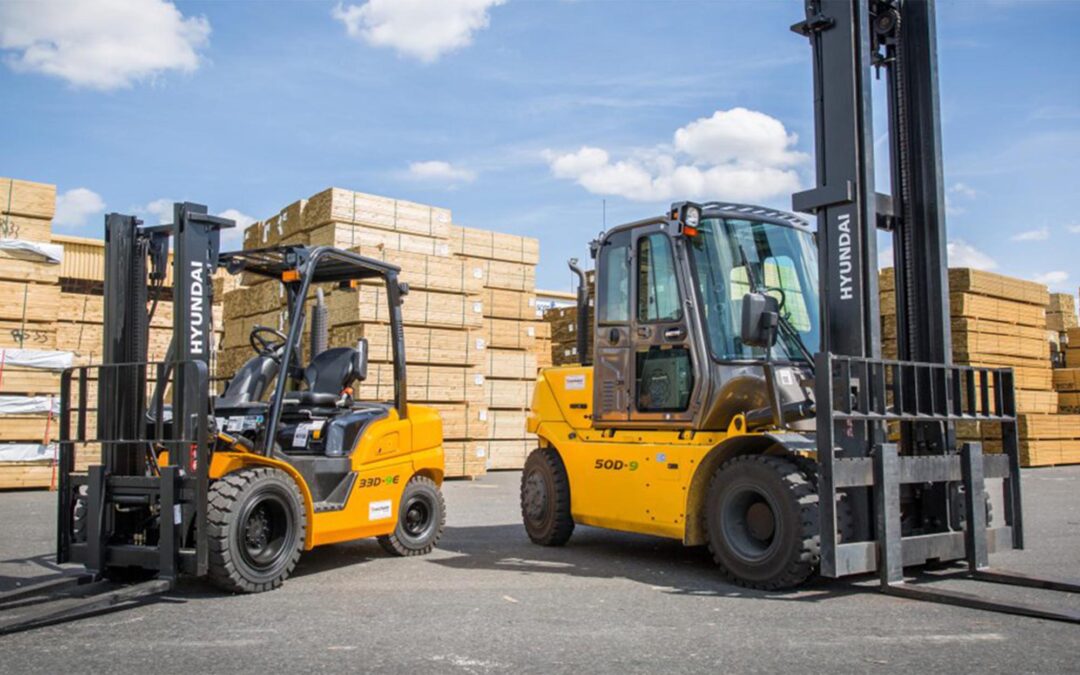
The Hyundai Class 4 forklift is designed with the operational detail that manufacturing environments require. As an official Hyundai dealer, Brennan Equipment Services carries the full Hyundai line with access to current models, factory support, and the technical expertise to match the right machine to your facility’s specific demands. Here is what makes Hyundai’s Class 4 equipment worth a closer look for teams running high-volume industrial operations:
- Ergonomic cab design that reduces operator fatigue across long shifts, contributing directly to both safety and sustained productivity throughout the workday
- Advanced brake systems built for responsive, consistent stopping in environments where foot traffic and powered equipment share the same floor space
- Enhanced safety features including load stability controls and visibility improvements that matter most in active, high-volume production environments
- Compact machine dimensions that work in facilities not designed or rebuilt to accommodate large outdoor equipment
- Broad capacity range that scales to the weight demands of automotive components, raw materials, and finished goods without requiring multiple machine types for different load profiles
For operations teams evaluating options across multiple facility types, the Hyundai Class 4 forklift stands out as a machine that has been engineered for environments where reliable performance is not optional.
The Real Cost of Getting Equipment Wrong
It is worth pausing on what the wrong equipment decision actually costs over time. Mismatched equipment does not just create inconvenience: it compounds across every shift, every load cycle, and every maintenance call. The consequences tend to show up in a few predictable ways:
- Higher acquisition and operating costs when over-spec’d outdoor equipment is brought in for an indoor job it was never designed to do
- Reduced maneuverability that forces workflow redesign or slows throughput in facilities where aisles were not built with oversized equipment in mind
- Increased breakdown frequency when under-spec’d machines are pushed beyond their load or shift-length limits on a daily basis
- Pressure on service teams who end up managing chronic equipment failure instead of scheduled preventative maintenance
- Eroded total cost of ownership as unplanned repairs and downtime accumulate over the life of the machine
The Hyundai Class 4 forklift occupies the right zone for automotive and manufacturing applications. It is not outdoor-grade equipment trying to do an indoor job, and it is not a light-duty lift straining against loads it was not built for. Matching capacity to application is the most straightforward path to protecting uptime, and getting that decision right from the start is what separates operations that run smoothly from ones that spend their maintenance budget reacting to problems that were avoidable.
The Right Equipment Makes All the Difference
Choosing the right forklift for a manufacturing environment is less about finding the most powerful machine available and more about finding the right match for how your facility actually operates. Load capacity, aisle geometry, shift length, and long-term service reliability all factor into whether equipment performs the way it needs to when the floor is counting on it.
The Hyundai Class 4 forklift is built for exactly the kind of environment that automotive assembly plants and general manufacturing facilities represent. With Brennan Equipment Services as your official Hyundai dealer, you get access to equipment that fits the job and the service team, parts inventory, and industry experience to keep it running. For facilities with shifting seasonal demand or project-based equipment needs, Brennan’s short- and long-term forklift rental options offer the flexibility to scale without a long-term purchase commitment.